Welcome to the first United States Association for Energy Economics quarterly newsletter of 2026! Each quarter, we will bring you engaging articles, expert opinions, member perspectives, and updates that reflect the dynamic landscape affecting the economics of the energy industry. This edition features a variety of member voices, a reminder that the call for papers for November's USAEE/IAEE North American Conference is now open (be sure to submit by May 18!), and more. Your feedback is invaluable to us, so please reach out to share your thoughts, article ideas, and questions at usaee@usaee.org.
A Message from the President
BY GREG UPTON | PRESIDENT, USAEE
It is a great honor to serve as President of the United States Association for Energy Economics (USAEE). Having been involved with both USAEE and the International Association for Energy Economics (IAEE) for many years, I am deeply appreciative of the role this community has played in my own professional development. Like many of you, I have benefited not only from the exchange of ideas, but also from the relationships and collaborations that make this organization unique.
USAEE has always been a volunteer-driven association, and that spirit of service is central to its success. This year, one of my primary goals has been to expand opportunities for member engagement through our committee structure. I want to sincerely thank everyone who responded to the recent member volunteer survey. The level of interest has been extraordinary. We are currently compiling committee assignments, and members will be hearing more in the coming weeks. It is already clear that we will have a record number of participants involved in USAEE’s work, and that is a testament to the strength and commitment of this community. I would also encourage you, when you see members of the USAEE Council at this year’s conference, to thank them for their service. Every Council member is a volunteer, and their contributions represent a significant investment of time and effort on behalf of the association.
Be sure to mark your calendar for the 43rd USAEE/IAEE North American Conference November 15-18, 2026 in Pittsburgh! While conference registration will open soon, reservations are available NOW at the conference host hotel, the DoubleTree by Hilton Hotel & Suites Pittsburgh Downtown at the special USAEE group rate of $159 per night. Now is also the time to submit your work for the conference...
Call for Papers:
43rd USAEE/IAEE North American Conference
The United States Association for Energy Economics (USAEE) and International Association for Energy Economics (IAEE) are now accepting submissions for November's 43rd USAEE/IAEE North American Conference in Pittsburgh. The deadline for receipt of full sessions and individual works is May 18.
Concurrent sessions at the conference allow students, academic faculty and staff, energy economists, and practitioners who are working in business, government, and research communities to present current analysis, research, or case studies on topics that are related to energy economics and markets. Presentations may be based on academic papers, but this is not a requirement. Presentations are intended to facilitate the sharing of both academic and professional experiences and lessons learned.
Dallas Fed Explores How the U.S.
Will Power the AI Boom
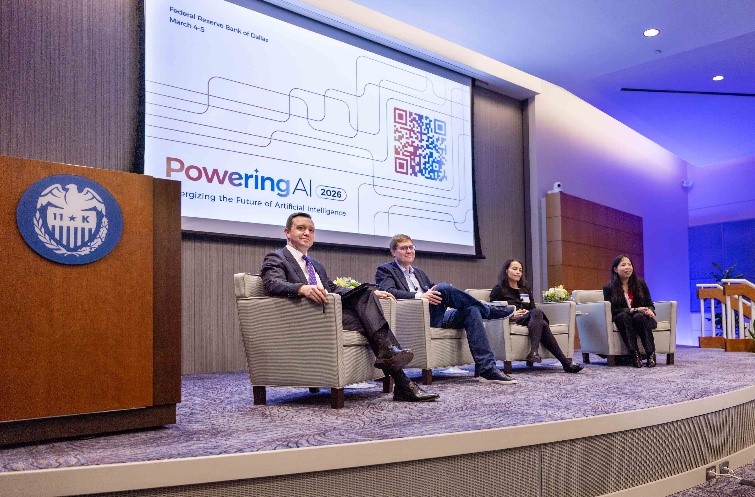
During the Federal Reserve Bank of Dallas Powering AI conference, Assistant Vice President of Energy Programs Garrett Golding, left, moderates a panel with Clark O’Niell, Boston Consulting Group; Bernadette Johnson, Enverus; and Ning Lin, Bureau of Economic Geology at the University of Texas at Austin.
BY GARRETT GOLDING | ASSISTANT VICE PRESIDENT, FEDERAL RESERVE BANK OF DALLAS
The Federal Reserve Bank of Dallas hosted a two-day conference March 4-5 examining how the United States will power its artificial intelligence (AI) ambitions. A leading constraint to the buildout of AI infrastructure is access to reliable and affordable power. A surge in power generation and transmission investment at this scale has not occurred in decades, and the stakes of winning the AI arms race could not be higher.
The Powering AI event brought together energy, technology, and financial executives and experts to address the intersection of explosive AI demand for electricity and constraints in power generation, financing, and grid management.
The conference revealed that powering AI is less about technological impossibility and more about coordination challenges across infrastructure, finance, policy, and communities. The industry has the generation capacity, the capital, and increasingly the demand flexibility to continue its growth. But unlocking this potential requires transparent commitments, regulatory reform, community engagement, and workforce development. As one panelist emphasized: "This is a national security issue." The ability to deploy AI infrastructure will determine competitive positioning in the global technology race.

James L. Smith
This is the latest article in a series featuring distinguished USAEE members reflecting on their careers and their involvement in the USAEE community.
Being involved in USAEE has meant many things to me, mainly falling into the categories of “work hard” and “play hard.” It is difficult to sustain the first without the second, and hard to justify the second without the first. USAEE provides ample opportunity for both. When I first joined IAEE, the USAEE had yet to be established and energy economics was very much a niche field. The major journals had only recently appeared (Resource & Energy Economics in 1978, Energy Economics in 1979, and The Energy Journal—our flagship—in 1980). In most universities few colleagues were available with whom to debate and share ideas, even fewer textbooks and teaching materials existed—let alone students who would use them, and opportunities to present one’s research to the broader world were limited.
IAEE/USAEE changed that and gave greater purpose to one’s work by creating a community—large, diverse, and comprehensive in the scope of its interests and activities. The resources and opportunities created by both USAEE and IAEE, mainly in the form of publications and conferences, both spurred and supported my research effort.
Academic Focus: Matthew E. Oliver
I am an associate professor in the School of Economics at Georgia Institute of Technology. I received a BBA in Economics from the University of Memphis in 2008, and my PhD in Economics from the University of Wyoming in 2013. I have been an active member of USAEE for 13 years.
My research is primarily in the field of energy economics. Specifically, the main thrusts of my work might best be described as occurring at the intersection of energy economics with (1) environmental and natural resource economics, (2) industrial organization, and/or (3) development economics. Much of my early research was on natural gas markets and the economics of pipeline transmission. More recently, my work has largely focused on economic issues related to renewable energy, specifically the effects of renewable generation intermittency on electricity markets and the effects of rooftop solar on household energy consumption behavior (e.g., the solar rebound effect). Methodologically, the core of my approach is applied microeconomics, and I have both published and working papers that employ microeconomic theory, reduced-form econometrics, and numerical simulation methods.
Call for Papers: IAEE Sessions at ASSA 2027
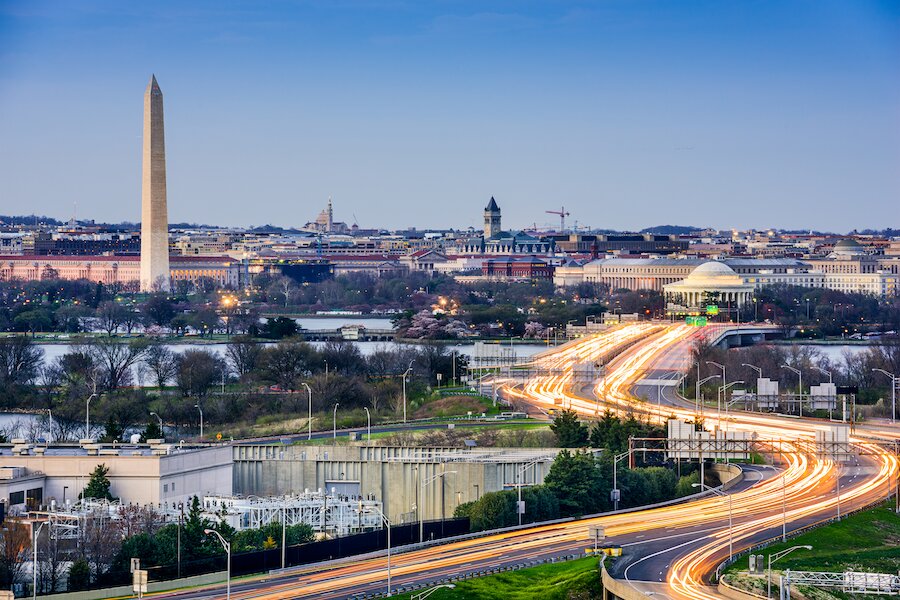
Submissions are now open for the International Association for Energy Economics (IAEE) and United States Association for Energy Economics (USAEE) sessions at the 2027 Allied Social Sciences Association (ASSA) Annual Meeting, January 3-5 in Washington, DC. The deadline for submissions is now April 20.
We invite submissions on all topics related to energy economics and environmental economics for consideration in our program. Each session will consist of paper presentations followed by a discussant’s commentary.
USAEE/IAEE Working Paper Series
The USAEE/IAEE Working Paper Series gives all members a chance to increase the circulation, visibility, and impact of their research. If you have an unpublished research paper that addresses any aspect of energy economics or energy policy, we would like to feature your paper in this new series. There is no cost to you, only benefits:
- Place your work where it can be seen and used on a daily basis.
- Gain timely feedback from other researchers working on related topics.
- Create a permanent and searchable archive of your research output within the largest available Electronic Paper Collection serving the social sciences.
- Provide unlimited, hassle-free, public downloads of your work on demand.
- Raise your research profile, and that of the USAEE/IAEE, by joining with fellow members to establish a new energy research trademark that is unparalleled in terms of its breadth and depth of focus.
- Have a chance to win a complimentary registration to attend one of IAEE’s conferences.
S&P Global:
Regime Shock in Tehran: What Next?
This essay was originally published in the S&P Global Insight Blog and reflects the insights of Carlos Pascual, head of geopolitics and international affairs at S&P Global Sustainable1.
The confirmed killing of Iran's Supreme Leader, Ayatollah Ali Khamenei, alongside the head of the IRGC and other senior commanders, marks a massive geopolitical rupture. This was not simply a decapitation strike; it was the removal of the Islamic Republic's central nervous system.
Iran's system was built to balance clerical authority, military power, and factional politics under a single arbiter. Iran's arbiter for 37 years is gone. A new Supreme Leader, appointed March 8, will determine whether Iran consolidates, fractures, or lashes out in ways that redraw the strategic map from the Gulf to global markets.

